New Digital Resource: Index of Annual Exhibition Jurors (1882–1969)

The Archives is happy to announce a new digital research tool: the Index of Annual Exhibition Jurors. This resource provides a centralized, searchable record of the jurors who shaped one of the most significant exhibition series in American art history.

From the inception of the juried system in the late 19th century through the final annual in 1969, the information provide valuable research details for researchers, curators, and historians tracing the evolution of American taste and institutional standards.
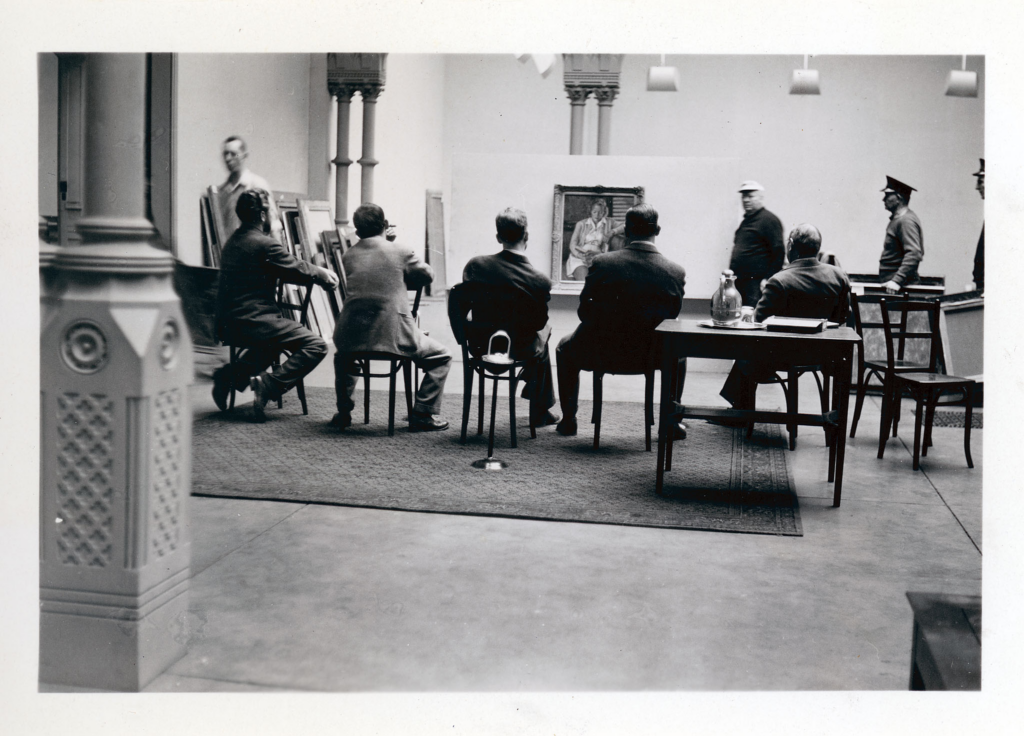
1942 Annual Exhibition Jurors (PC0104_1942_003)

Access the Resource: Index of Annual Exhibition Jurors

Key Research Data & Insights

The database allows for a granular analysis of PAFA’s institutional decision-making. Initial findings from the data reveal several significant trends:

  • Institutional Influences: The records document the recurring involvement of important Academy instructors, including Thomas Eakins, Cecilia Beaux, William Merritt Chase, Thomas Anshutz, Hugh Breckenridge, and Charles Grafly.
  • Specialized Jury Structures: The data tracks the professionalization of the jury system, ranging from “Hanging Juries” responsible for gallery aesthetics to specialized committees for Painting, Sculpture, and Architectural Drawings.
  • Geographic Reach: Documentation of regional juries in St. Louis, Chicago, Cleveland, and Indianapolis demonstrates the Academy’s historical role as a national arbiter of fine arts.
  • Gender and Professional Status: Researchers can track the increasing—though initially limited—inclusion of women in leadership and jury roles, providing a metric for shifting professional standards in the early 20th century.

Why This Matters for Scholarship

The Annual Exhibitions at PAFA brought over 100,000 works of art to the public. By making the names and roles of the jurors accessible, we provide the “missing link” in provenance and exhibition history research. Understanding who selected the art is as vital as knowing which art was shown.

This digital resource reduces the need for manual catalog searches, streamlining the workflow for provenance researchers and academic historians.
European Roots of America’s First Art Academy

Contributed by Sharon Yoon, Collections and Technical Services Assistant

In the early 19th century, the Pennsylvania Academy of the Fine Arts (Academy) functioned as a vital conduit for transatlantic cultural exchange. For a young nation lacking established museums or classical ruins, these early acquisitions provided the essential technical infrastructure required to train American artists before a native artistic identity had fully emerged.

The Napoleonic Gift (1810)

In 1810, a significant diplomatic exchange occurred between the French Empire and the United States. John Armstrong Jr., the American Ambassador to France, received a collection of books and engravings from Napoleon Bonaparte, delivered via the Duke of Cadore.

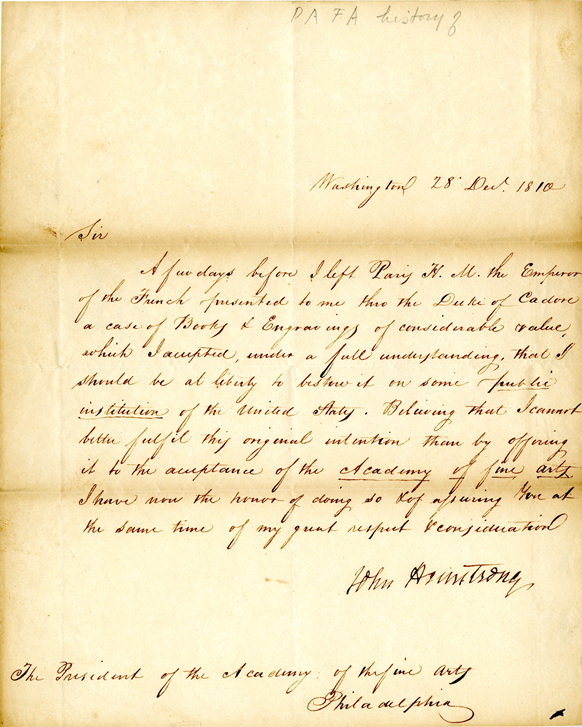
Armstrong recognized the pedagogical value of these materials for a young art institution. In a letter dated December 28, 1810, he formally offered the collection to Academy President George Clymer:

“Believing that I cannot better fulfil this original intention than by offering it to the acceptance of the Academy of Fine Arts, I have now the honor of doing so…”

Washington 28 Dec. 1810

Sir

A few days before I left Paris H. M. the Emperor of the French presented to me thro’ the Duke of Cadore a case of Books & Engravings of considerable value, which I accepted under a full understanding, that I should be at liberty to bestow it on some public institution of the United States. Believing that I cannot better fulfil this original intention than by offering it to the acceptance of the Academy of Fine Arts, I have now the honor of doing so and of assuring you at the same time of my great respect and consideration.

John Armstrong

The President of the Academy of the Fine Arts

Philadelphia

This gift comprised 24 volumes of etchings by Giovanni Battista Piranesi and his family. These detailed renderings of Roman architecture became primary teaching resources, allowing Academy students to study classical proportion and perspective without traveling abroad.

The Smith Donation and International Law (1813)

The Academy’s instructional library and collection were further expanded in 1813 by a major gift from Joseph Allen Smith, consisting of paintings, plaster casts, and engravings.

The provenance of this collection is a landmark in international law. During the War of 1812, the ship transporting Smith’s gift was seized by the British as a “war prize.” However, a Nova Scotia Vice-Admiralty Court eventually ordered the cargo’s release. The ruling established a global precedent: that cultural and scientific property are exempt from the rights of warfare—a principle that remains a cornerstone of international art law today.

For more information on the ship seized by Britain:

A Legacy of Modern Scholarship

Together, the Napoleon and Smith gifts provided the intellectual capital necessary for America’s first art academy. These resources remain active assets for modern scholarship. Recently, researcher Stephen Lauf consulted the Piranesi volumes to advance his research on 18th-century printmaking and architectural history. Such collaborations continue to generate new insights into the Academy’s foundational holdings. His multiple visits to the archive were a delight to staff and sparked multiple interesting conversations on the works, processes, and history of the Piranesi family etchings. Thanks to Lauf, Academy staff also walked away from his visits with new knowledge and insights into the volumes.

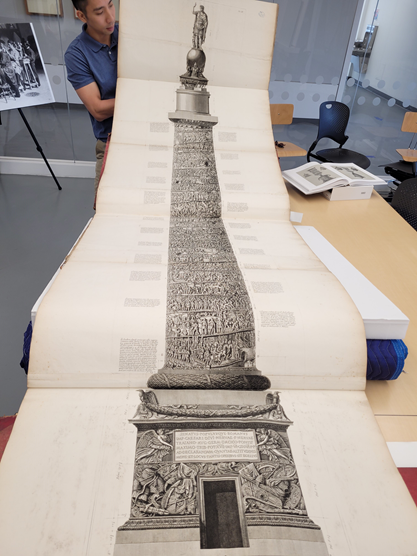
Director of Archives, Library, & Collections Hoang Tran unfolding Trajan’s Column!
Photo courtesy of Stephen Lauf

For more information on Lauf’s interesting research, please visit his website: https://www.quondam.com/index.htm

Through the preservation of these imperial and diplomatic gifts, the Academy ensures that the fundamental resources that shaped the first generations of American artists remain accessible to inspire the next.

Reflecting on 2025: How We Connected with History and Art

As we wrap up 2025, we’re taking a moment to look back at how you—our researchers, students, and curious visitors—interacted with the Academy’s collections over the past year.

These patterns are more than just numbers on a spreadsheet; they offer a window into our community’s evolving needs and help us map out our future. It’s important to note that these figures focus specifically on research and resource requests—things like deep dives into our archives, library services, and access to works of art not currently on public display.


2025: A Year of Purposeful Research

In 2024, the Academy recorded 923 total research requests. As of mid-December 2025, that number stands at 892. While this is a slight 3.4% dip, the story behind the data is one of resilience.

This minor decrease was expected as the Academy transitioned away from degree-granting programs, leading to a smaller student population this fall. However, demand remains remarkably robust.

The Breakdown of Requests:

  • External Requests (63%): 562 inquiries came from the research community.
  • Internal Requests (37%): 330 inquiries supported our faculty, staff, and students.

The Digital Frontier: Global Reach, Human Connection

While our physical halls have seen shifts, our digital presence is exploding. The Academy’s Digital Archives recorded over 100,000 unique human visitors this year!

A standout star of our digital offerings remains the Rediscovering John Rhoden Digital Archives, which drew over 3,100 unique visitors. We are honored to continue stewarding Rhoden’s incredible legacy for a global audience.

New to the Digital Collection this year:

We’ve added 2,475 new items across three collections:

  1. PAFA Course Catalogs: A journey through our institutional history.
  2. Blanche Dillaye Drawings: Exquisite works now available to all.
  3. Chester Springs Student Registration Cards: A treasure trove for genealogists and historians.

A “New Normal” for In-Person Visits

How you visit us is changing. While email remains the primary way researchers start their journey, we’ve seen a “hybrid” rhythm emerge.

  • The Archives are Booming: In-person use of the Archives surged by 122% (111 visitors).
  • The “Walk-In” Surprise: We saw an unexpected rise in walk-in service, largely driven by our new cohort of certificate students seeking hands-on support.
  • A Shift in Scale: Total in-person interactions dropped from 885 to 428. This 52% decline was anticipated following the school’s transition, but it has paved the way for more focused, scholarly engagement.

Top 3 Reasons People Use the Archives:

  1. Academic Research
  2. Curatorial Research
  3. Provenance Research

What These Shifts Mean for Our Future

The data tells us three important things:

  1. Demand is High: Projects like the “A Nation of Artists“ exhibition and our upcoming 220th Anniversary celebrations continue to drive intense interest in our holdings.
  2. Archives are Essential: The massive jump in archival research proves there is a deep hunger for primary-source materials.
  3. Intentionality Wins: Visitors are coming to us with more specific, deep-seated goals. Our digital archives are serving as a gateway, allowing researchers to do their “homework” online before arriving for a high-impact physical visit.

Looking Ahead

These insights are vital. They allow us to plan responsibly—ensuring we balance broad digital access with the specialized, high-touch care required for on-site research.

Whether you reached out via email, spent hours in the reading room, or browsed our catalogs from across the ocean: Thank you. Your curiosity is what brings these collections to life. We can’t wait to see what you discover in 2026!