A Seeker of Light: The Enduring Legacy of Dr. Monico C. Calma
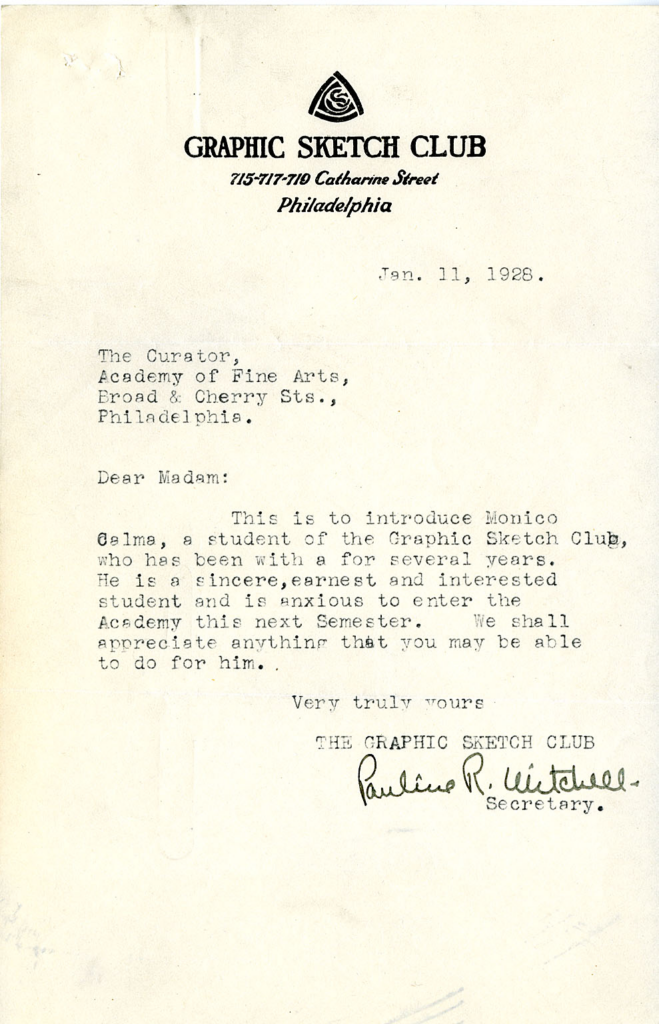
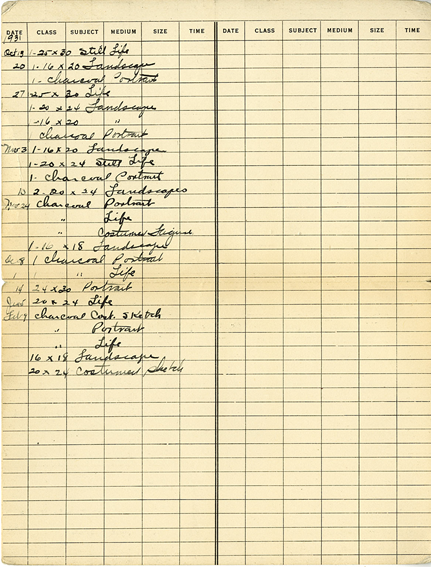
Archives are often viewed as static repositories, but they are most vital when they provide a foundation for active inquiry. During the summer of 2023, a research project by our intern Catherine Wan into the student records of Dr. Monico C. Calma (1905–1987) led to an ongoing effort between our institution and the Calma family to document the life of a former PAFA student.
By tracing Dr. Calma’s journey from his 1927 enrollment to his time as a Cresson Traveling Scholar, we have worked with the family to help fill in narrative gaps regarding his career after leaving Philadelphia. We are pleased to use our platform to share this work, as it reflects our commitment to honoring the accomplishments of Academy trained artists.
From Archive to Memoir
The collaboration has culminated in the family’s publication of Scraps of a Man’s Life, a memoir that expands upon the primary sources held in our collection. While our files document the official facts of his attendance, the manuscript provides a personal, human context. It captures the reality of a life balanced between manual labor in Alaskan salmon canneries and the rigorous, high-art environment of the Pennsylvania Academy of the Fine Arts and the Graphic Sketch Club.
A Bridge Between Labor and Art
Scraps of a Man’s Life is visually compelling, enriched by Dr. Calma’s original photography and sketches. These materials document a specific era with an intimacy that administrative records cannot replicate.
The manuscript details his evolution from a student seeking to “earn a good name” to a mature artist who declared, “For me alone, seeking to create what is beautiful is first.” His journey—marked by his 1931 European Traveling Scholarship and his return to the Philippines in 1936—offers a vital, firsthand account of the “Manong” generation experience.
Preserving a Shared History
The family’s dedication to curating this memoir serves as an essential contribution to the broader conversation regarding the Filipino experience and contributions to the international cultural fabric. By providing visibility to this project, we hope to ensure that this “seeker of light” remains a recognized figure in the story of international art education and PAFA’s role in training artists.
For those interested in the intersection of identity, education, and the immigrant experience, this memoir serves as an honest testament to one man’s pursuit of his craft. If you’d like to check out the manuscript, you can find it over on Amazon. Just a quick note: we don’t make any money or get paid for sharing this link, we just want to make it easy for you to find!
Note: The Pennsylvania Academy of the Fine Arts is pleased to highlight this research and the family’s memoir as a matter of historical interest. Please note that this is for informational purposes and does not constitute an institutional endorsement of the publication.
Before he became one of America’s most celebrated impressionists and a cornerstone of the New Hope art colony, Edward Redfield (1869-1965) was a student honing his craft at the Academy. We are thrilled to announce the recent acquisition of a small collection of Redfield’s student works, created between 1887 and 1889. These are particularly unique as students rarely preserved any of their student work.
The complete digitized collection is now fully accessible online via our Digital Archives, offering researchers, students, and art enthusiasts free access to these foundational works. Explore the new collection today and trace the early steps of a master landscape painter.
Collection Highlights
Pedagogical Insight: Gain a rare window into the traditional academic curriculum that shaped a generation of American masters under the influence of the Eakins-era PAFA framework.
Foundational Studies: Explore early technical exercises, including meticulous plaster cast and architectural ornament studies of leaves, hands, and feet.
Life Drawings: View advanced charcoal and graphite nude figure studies that demonstrate the rigorous anatomical training of the late 19th-century academy.
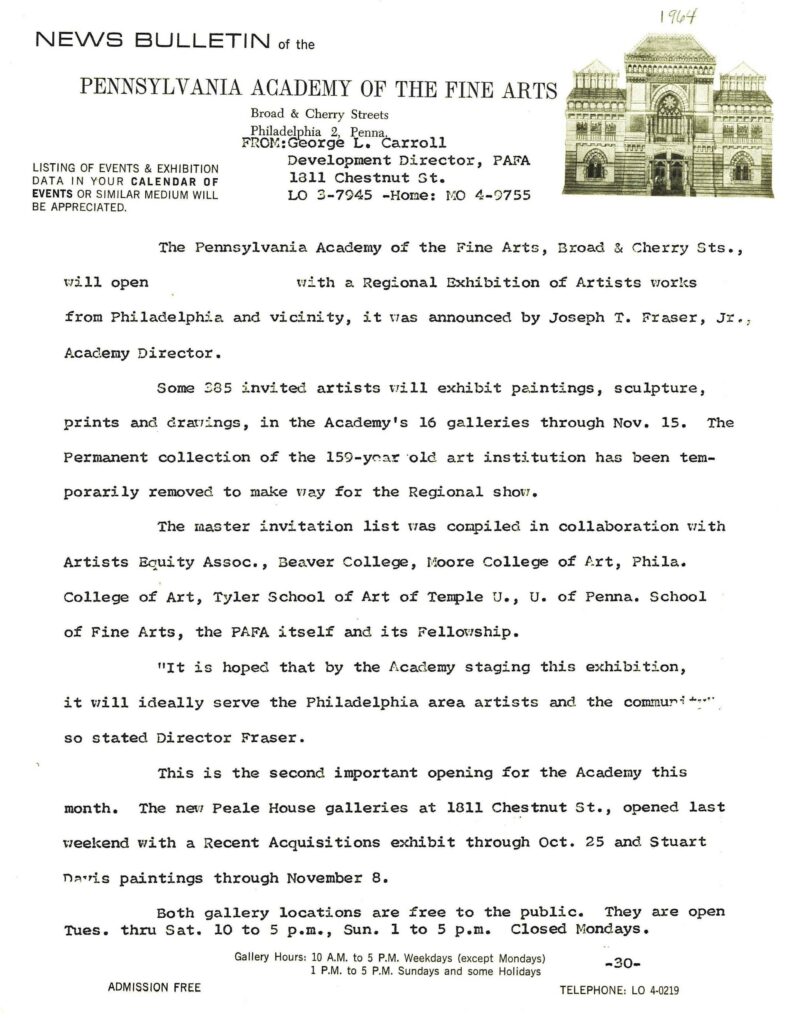
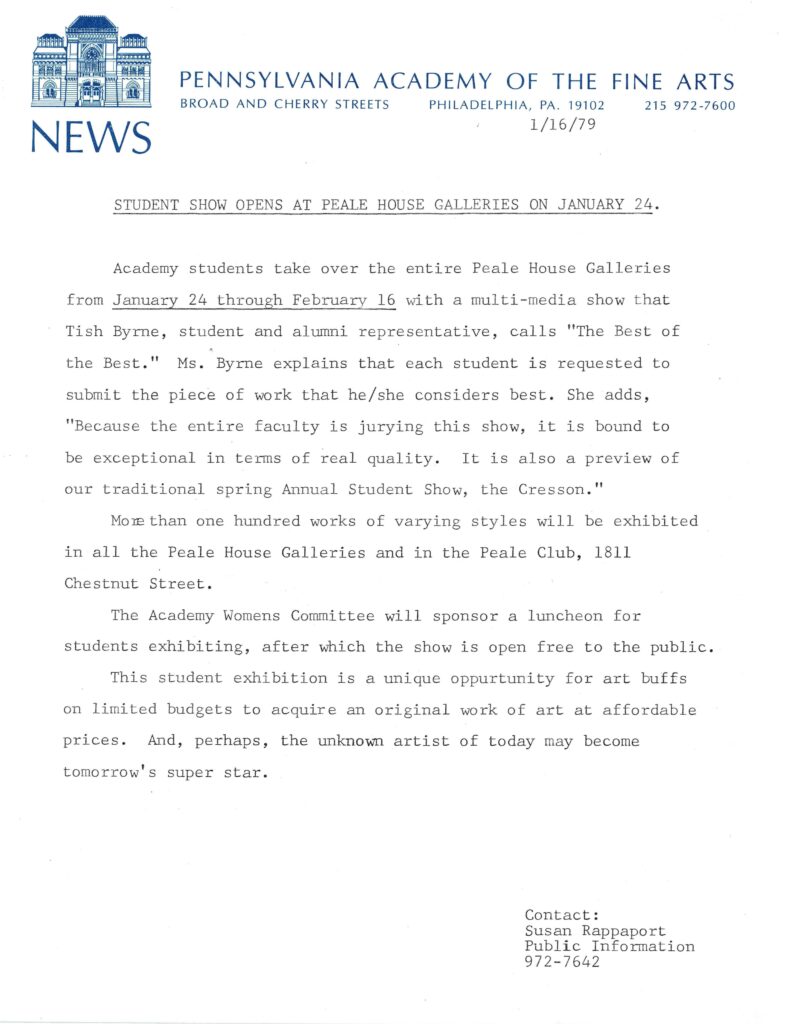
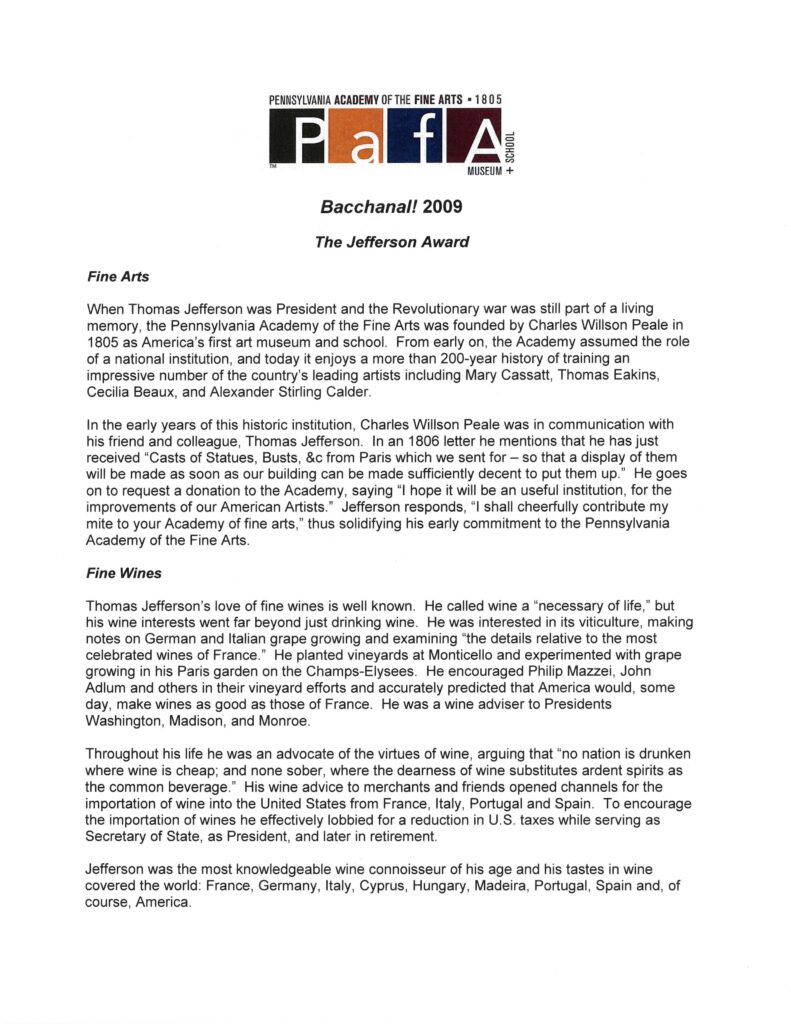
The Pennsylvania Academy of the Fine Arts (PAFA) has played a central role in the cultural life of Philadelphia and the broader American art world for more than two centuries. A newly digitized archival collection of PAFA press releases, spanning the years 1930 to 2020, offers a unique window into how the institution has presented itself, its collections, and its programs to the public across nearly ninety years of change.
Press releases are often created for immediate use, but when viewed over time, they become a rich historical record. The materials in this collection document PAFA’s exhibitions, educational programs, acquisitions, public events, and institutional milestones, while also reflecting shifting priorities in museum practice, art education, and public engagement. From early twentieth-century announcements highlighting juried exhibitions and prominent American artists to late twentieth- and early twenty-first-century releases focused on contemporary art, community outreach, and digital initiatives, the collection traces PAFA’s evolving voice and mission. Variations in the Academy branding can be seen, which also reflect internal institutional changes.
The press releases also capture broader trends in the arts and cultural sectors. Changes in language, format, and design reveal how communications strategies adapted to new media environments and audience expectations. For historians, researchers, and students, this collection provides valuable primary source material.
All materials in this collection have been digitized to improve access and support research. The digital files reflect the original documents as closely as possible, including variations in layout and presentation that illustrate how institutional communication practices changed over time. By making these press releases available online, PAFA’s archives aim to preserve an important record of the institution’s public history while inviting new audiences to explore and engage with it.
This digitized collection underscores the value of administrative and communications records as historical resources. What began as routine announcements now offers a long-view perspective on nearly a century of artistic activity and cultural change at PAFA.
Contributed by Sharon Yoon, Collections and Technical Services Assistant
About Chester Springs:
From 1917 to 1950, the Pennsylvania Academy of the Fine Arts (Academy) operated its “Country School” in Chester Springs, Pennsylvania. Located 33 miles from the Historic Landmark Building, the campus expanded from an initial 40-acre tract in 1916 to over 160 acres by 1950. The program was established during the early 20th-century movement toward summer landscape painting—a pedagogical legacy of the Impressionist movement—and eventually expanded to include winter sessions from 1928 to 1933.
The site offered significant historical and artistic depth. Situated at the source of three natural springs, the property served as a medicinal spa prior to the American Revolution and as a hospital during the Valley Forge encampment. The Academy converted the existing village of Yellow Springs into a functional academic environment: a former hotel served as a dormitory, while various agricultural buildings were repurposed into studios. This setting provided students with diverse subject matter, ranging from local industry and steel mills to cultivated gardens and livestock. Although the facilities remained open year-round, formal instruction and critiques were conducted in concentrated six- to eight-week sessions.
According to the first school circular, Chester Springs was devoted to
“fine-art instruction in the open air, with all the beautiful surroundings of nature herself, in order to supplement instruction within the walls of class-rooms, and to afford an opportunity, for the study of art in the summer, to school teachers and to others who cannot spare the time to study in the winter.”
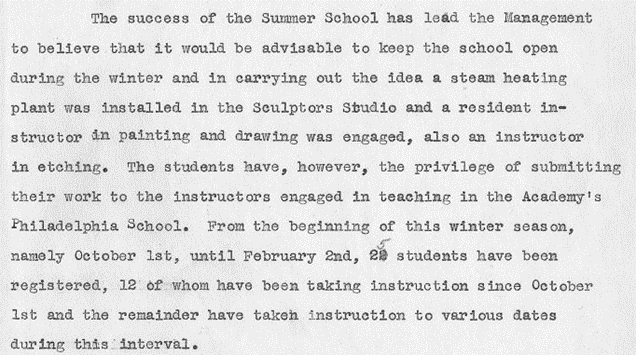
While the Chester Springs facilities were maintained year-round, formal instruction was initially restricted to the summer months. Following the sustained success of the Summer School, the Academy inaugurated a Winter School in 1928. These winter sessions continued for five years until 1933, when they were discontinued due to the prevailing economic climate of the Great Depression.
122nd Annual Report, 1927
129th Annual Report, 1934
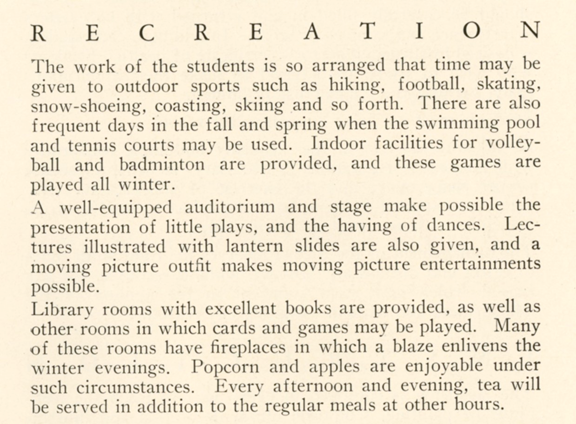
Beyond its role as a school, the Academy administrators envisioned Chester Springs as a burgeoning artists’ colony. The idyllic setting, paired with robust studio facilities, fostered a deeply immersive creative community. Life at the “Country School” was defined by a unique social contract: students were expected to be self-governing, adhering to a code of honor rather than a rigid rulebook.
This independence extended beyond the studio. Artists integrated themselves into the local fabric, collaborating with residents, staging original performances, and even taking an active hand in the landscaping of the grounds. The vibrant campus life—from its historic buildings to its community events—became a central selling point for the program, frequently highlighted in school catalogs as a defining feature of the Academy experience.
1932-33 Winter Catalog
While the Country School was characterized by a seemingly informal atmosphere, the caliber of work produced consistently met the Academy’s exacting standards. Students at Chester Springs were fully integrated into the Academy’s competitive ecosystem, exhibiting their work in dedicated showcases and competing for the same prestigious prizes as those studying at the Historic Landmark Building.
The program’s reputation was anchored by a faculty of distinguished artists and lecturers, including Daniel Garber, Henry McCarter, George Harding, Albert Laessle, Leon Kroll, Francis Speight, Roswell Weidner, and N.C. Wyeth. Their presence ensured that the pastoral setting remained a site of serious technical inquiry and professional development.
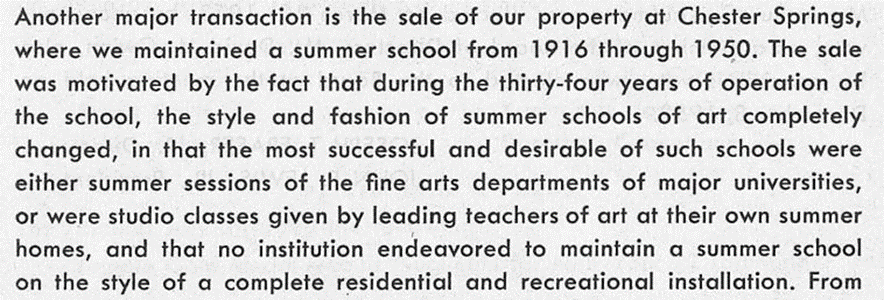
After more than three decades of operation, the Academy discontinued the Country School and sold the property in 1952. Today, the site’s legacy continues through Historic Yellow Springs and The Chester Springs Studio. The Academy maintains a collaborative relationship with these organizations, preserving the tradition of summer landscape instruction on these historic grounds.
147th Annual Report, 1952
About the Project:
The Archives launched this project to revitalize a significant but underutilized chapter of our history. For years, the records of the thousands of artists who trained at our Chester Springs campus remained under-recognized due to a lack of searchable data. To bring this history to light, our archives team leveraged the help of eager student volunteers who were instrumental in transforming these analog files into a modern digital resource.
This specific body of work was selected because it is a discrete collection that perfectly aligns with the four strategic pillars of the Academy’s Archives and Special Collections:
Preservation: These cards are 70 to 100 years old. Digitizing them allows us to reduce physical use, preventing further wear and tear.
Discovery: We have extracted specific metadata—including artist names, enrollment dates, and gender—making it significantly faster for researchers to find exactly what they need.
Access: By removing the requirement for in-person appointments, we have eliminated geographic barriers. Anyone with an internet connection can now access and view the entire collection.
Use: These records have been given new life for academic research, genealogical projects, and classroom instruction, reaching a much wider audience than previously possible.
To transform the analog Chester Springs registration cards into a digital collection, our team employed a flatbed scanning workflow. The bulk of the archives’ digital collections use the flatbed scanner workflow for a few reasons:
Streamlined Training: The intuitive flatbed interface allowed student workers to achieve proficiency quickly, significantly reducing the initial learning curve.
Minimized Post-Processing: By manually adjusting the scan area for each card during the capture phase, we eliminated the need for bulk digital cropping or rotation after the fact. This “correct-at-capture” approach ensured that the digital files were ready for immediate use.
Quality Control: Technicians verified the clarity and alignment of each scan in real-time. Given that the informational content was the primary priority for this project, this manual oversight was essential to ensure every handwritten note and address was legible.
Throughput: Each scan took approximately 30 seconds, averaging 60 to 90 seconds of active labor per student record. All images were saved as high-resolution TIFF master files with unique identifiers.
Technical Challenges: Size Variance
While the cards were standard 4×6 inch index cards, we encountered physical variations across the collection’s 34-year span. Because the records are organized alphabetically rather than chronologically, card sizes often fluctuated by increments of less than 1/8th of an inch from one folder to the next.
This variance required constant technician intervention:
Adjustments: Student technicians had to manually reselect the scan area frequently—particularly for folded cards—to ensure that no text was lost.
Manual Cropping: Standard digitization software captures a preselected “window” on the scanner bed.
Edge Integrity: If the capture window was set too tightly for a smaller card, the edges of the subsequent, slightly larger cards would be clipped.
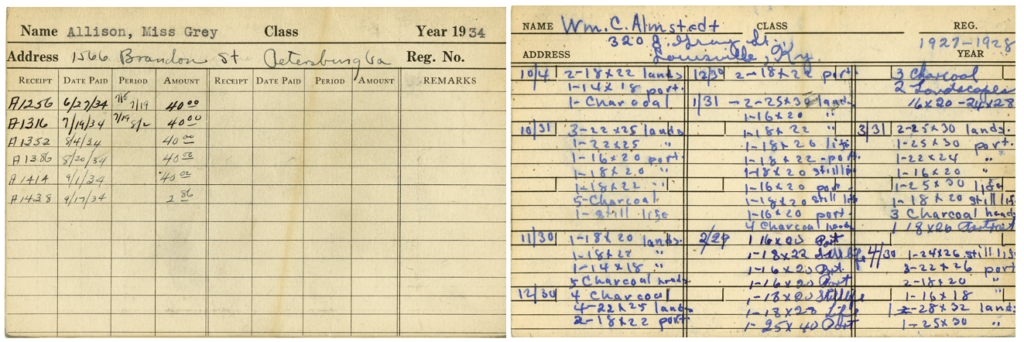
Two student registration cards; Almstedt being slightly larger than Grey (see right edge).
Maintaining the integrity of each record required constant manual intervention due to the variations of the cards. Because the informational content was the priority, we utilized a “capture-it-all” approach to ensure no data was lost during the digitization process.
Manual Area Selection: To account for size variances, staff and students manually adjusted the scan “window” for each card. This precision ensured that every registration card was captured in its entirety, preventing the loss of edge-aligned text or marginalia.
Variable Formats: While standard cards were two-sided, the collection included unique folded records. These required a three-scan sequence to capture the front, back, and the double-width interior face.
Real-Time Quality Control: Technicians performed intermittent file checks throughout each shift. By verifying image files immediately after capture, the team eliminated the need for costly and time-consuming re-scanning phases later in the project lifecycle.
Workflow Adaptability: Each change in card dimensions or format triggered a manual reselection of the scan area. This deliberate pace reduced the risk of “clipping” larger cards and ensured a consistent high-quality output across all 6,600 files.
Data Integration and Access Workflow
To maximize productivity, the team utilized a concurrent workflow for scanning and metadata entry. This “staged” approach allowed for continuous operation while maintaining a connection between the physical objects and their digital surrogates.
While the scanner processed one record, the technician transcribed the information for the subsequent card into a master spreadsheet. This parallel processing optimized labor hours and kept the project moving forward.
Transcription Challenges: Due to the prevalence of 20th-century cursive and varied handwriting styles, identifying specific names and dates occasionally presented difficulties. While every effort was made for accuracy, the archives acknowledges the potential for minor transcription errors.
Alphabetical Consistency: Technicians worked through the collection alphabetically. This organization allowed for a seamless hand-off between shifts, ensuring that any student worker could resume the project without disrupting the data sequence.
File Naming and Digital Provenance
To maintain archival standards, a naming convention was implemented:
Unique Identifiers: Each scanned side was assigned a specific alphanumeric code (e.g., RG030501-xxxx).
Collection Logic: The prefix RG030501 identifies the Chester Springs collection within the Academy’s record groups, while the final four digits denote the sequential file number.
Data Alignment: Technicians maintained high levels of focus to ensure that the spreadsheet row for each student precisely matched the sequential filename of the corresponding image.
Post-Processing for Access
Following the capture of the high-resolution TIFF master files, the archives implemented an automated post-processing phase:
Batch Conversion: Using a custom Photoshop batch action, the team converted the master TIFFs into web-ready JPG access files.
System Efficiency: This automation ensured a standardized file size and format for the online portal, significantly reducing manual labor during the final upload phase.
Summary of Impact
The Academy initiated this project to bridge a significant gap in our institutional history. For years, the lack of a centralized, searchable record left the legacy of the thousands of artists who trained at Chester Springs under-recognized. By transforming these analog records into structured digital assets, we have ensured that this vital chapter of American art education is preserved and fully accessible for modern scholarship.
As we wrap up 2025, we’re taking a moment to look back at how you—our researchers, students, and curious visitors—interacted with the Academy’s collections over the past year.
These patterns are more than just numbers on a spreadsheet; they offer a window into our community’s evolving needs and help us map out our future. It’s important to note that these figures focus specifically on research and resource requests—things like deep dives into our archives, library services, and access to works of art not currently on public display.
2025: A Year of Purposeful Research
In 2024, the Academy recorded 923 total research requests. As of mid-December 2025, that number stands at 892. While this is a slight 3.4% dip, the story behind the data is one of resilience.
This minor decrease was expected as the Academy transitioned away from degree-granting programs, leading to a smaller student population this fall. However, demand remains remarkably robust.
The Breakdown of Requests:
External Requests (63%): 562 inquiries came from the research community.
The Digital Frontier: Global Reach, Human Connection
While our physical halls have seen shifts, our digital presence is exploding. The Academy’s Digital Archives recorded over 100,000 unique human visitors this year!
A standout star of our digital offerings remains the Rediscovering John Rhoden Digital Archives, which drew over 3,100 unique visitors. We are honored to continue stewarding Rhoden’s incredible legacy for a global audience.
New to the Digital Collection this year:
We’ve added 2,475 new items across three collections:
How you visit us is changing. While email remains the primary way researchers start their journey, we’ve seen a “hybrid” rhythm emerge.
The Archives are Booming: In-person use of the Archives surged by 122% (111 visitors).
The “Walk-In” Surprise: We saw an unexpected rise in walk-in service, largely driven by our new cohort of certificate students seeking hands-on support.
A Shift in Scale: Total in-person interactions dropped from 885 to 428. This 52% decline was anticipated following the school’s transition, but it has paved the way for more focused, scholarly engagement.
Top 3 Reasons People Use the Archives:
Academic Research
Curatorial Research
Provenance Research
What These Shifts Mean for Our Future
The data tells us three important things:
Demand is High: Projects like the “A Nation of Artists“ exhibition and our upcoming 220th Anniversary celebrations continue to drive intense interest in our holdings.
Archives are Essential: The massive jump in archival research proves there is a deep hunger for primary-source materials.
Intentionality Wins: Visitors are coming to us with more specific, deep-seated goals. Our digital archives are serving as a gateway, allowing researchers to do their “homework” online before arriving for a high-impact physical visit.
Looking Ahead
These insights are vital. They allow us to plan responsibly—ensuring we balance broad digital access with the specialized, high-touch care required for on-site research.
Whether you reached out via email, spent hours in the reading room, or browsed our catalogs from across the ocean: Thank you. Your curiosity is what brings these collections to life. We can’t wait to see what you discover in 2026!
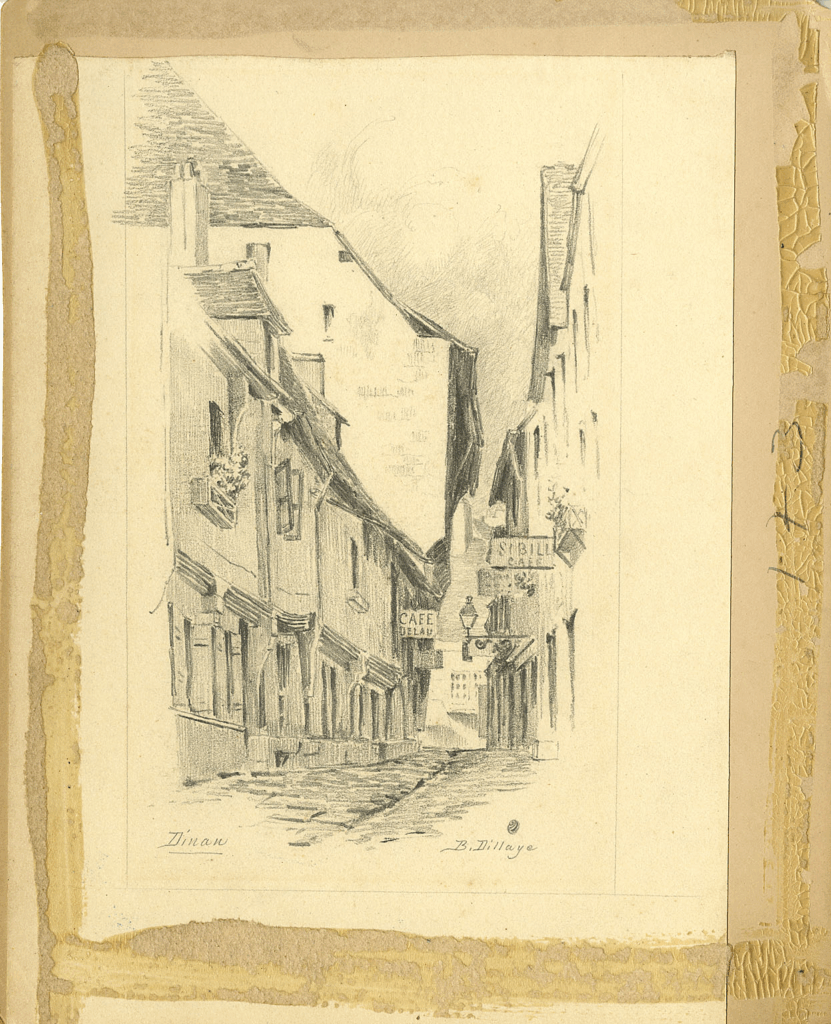
We’re thrilled to announce the recent acquisition and digitization of a remarkable collection of works by American artist Blanche Dillaye, dating from circa 1928. This newly available archive features 38 exquisite pencil sketches and one reflective poem, offering a rare glimpse into Dillaye’s travels and artistic vision during the late 1920s.
From the cobbled streets of Looe and Dinan to the architectural charm of Moret and the serene landscapes of Lelant, Dillaye’s drawings capture the textures, moods, and quiet beauty of European towns and countryside with masterful detail. Her accompanying poem, Trees, adds a lyrical layer to the collection, echoing themes of nature, presence, and timelessness.
Cobbled Street in Dinan, France (MS.2025.02-44)
Now fully digitized, this collection is open to researchers, educators, and art enthusiasts. Whether you’re studying early 20th-century travel sketching, American women artists abroad, or simply drawn to the elegance of pencil work, Dillaye’s collection offers rich material for exploration.
We are thrilled to announce the completion of a major digitization project within the PAFA Archives: The Chester Springs Student Registration Cards. (https://pafaarchives.org/s/digital/page/chester-springs) For decades, these cards have been the primary—and often the only—proof of a student’s time spent at PAFA’s historic summer campus. Now, for the first time, this entire collection is available online, offering a searchable window into the lives of over 2,300 artists who studied in the rolling hills of Chester County.
A Legacy of “Open-Air” Art
In 1917, PAFA embraced the Impressionist-led “plein air” movement by opening the Academy Country School (popularly known as Chester Springs). Located about six miles from Phoenixville on a site steeped in history—from a pre-Revolutionary medicinal spa to a Revolutionary War hospital—the campus offered 100 acres of creative freedom.
Until its closure in 1952, the school was a vibrant village of art. A former hotel served as a dormitory, while barns and sheds were transformed into sun-drenched studios. Students spent six-week sessions painting landscapes, open-air figures, and still lifes, balanced by games of tennis, croquet, and swims in the local pools.
What the Collection Reveals
The archives has digitized every single student registration card from the Chester Springs records. This extensive list of 2,315 individual names provides vital documentation that can confirm:
Personal Details: Registered names and home addresses.
Academic History: Specific dates of attendance and courses taken.
Financial Records: Tuition and fee payments.
Special Distinctions: Notes on veteran status (GI Bill), scholarship awards, and even dormitory assignments.
Each entry allows you to click the student’s name to view the scan of their original index card. Because many artists returned year after year, these cards are displayed sequentially to show their growth and history with the school.
Start Your Research: Specialized Browse Lists
To help you navigate this vast collection, we have curated several specialized categories. Whether you are a genealogist, an art historian, or just curious about the Academy’s history, these links provide a great starting point:
Browse Women Artists – Discover the significant number of female painters who shaped the Chester Springs legacy.
This project was made possible by the dedicated work of our staff and PAFA students. We would like to extend our deepest thanks to the project contributors:
Sharon Yoon, Museum Collections Assistant (Project Lead)
Hoang Tran, Director of Library, Archives, & Collections
A Note on Accuracy: While we have made every effort to transcribe these names accurately, historical handwriting can be a challenge! If you believe a name has been transcribed incorrectly, please contact the Archives.
Contributed by Sharon Yoon, Museum Collections Assistant
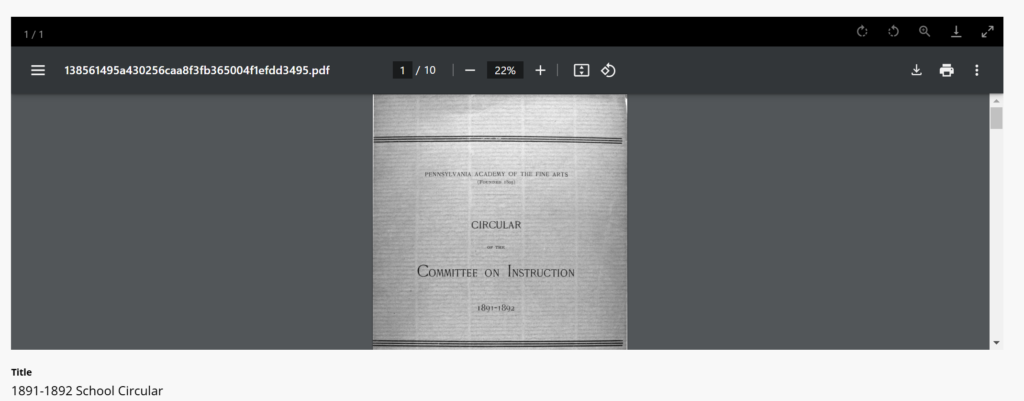
The PAFA School Catalogs are valuable archival records that help provide insight into over 130 years of school operations. Historically known as “Circulars”, the school catalogs provided students and prospective students with information such as school policies, programs, scholarships, schedules, fees, prizes, and instructors. After 1908, the catalogs included illustrations of classes, work by students, and exhibitions of student work. Catalogs from the 1920s show many views of classes and grounds at the Chester Springs campus. From 1940, photographs of faculty and their work were prominently featured.
The catalogs provide important details on the curriculum, the instructors, and the overall artistic training environment at the Academy, making the collection particularly useful to those interested in 19th and 20th century American Art education.
As there were over 100 catalogs (and nearly 4,000 pages!) to digitize, using a flatbed scanner for this project would have been time-consuming and inefficient for staff. Moreover, since the text was the most important aspect of the records, we were less concerned about the overall “image quality”. However, as mentioned in the previous blog post, a large obstacle that presented itself during this project was post-processing. Each image needed to be individually rotated, cropped, and color corrected. Afterwards, all the pages had to be converted and combined into a PDF file. These files were then organized by year and run through OCR software, which recognizes and converts text within images to be machine readable. Finishing this step resulted in 118 digital reproductions of the Academy’s school catalogs that are now freely available online: https://pafaarchives.org/s/digital/item-set/29807
We are excited to announce that the archives has completed digitizing a few more photograph collections. The work was completed by Victoria Black (MFA), the archives’ winter work-study student.
The first collection consists of 679 photographs that document the various prizes that students compete for, typically at the end of the school year. These prizes are sometimes referred to as the Spring Scholarship and Prize Competitions.
The second collection consists of 149 photographs that document the Edmund Stewardson Prize in Sculpture. The annual prize is competed for by students of the Academy. The subject for the competition is a full-length figure from life, in the round.
Opening this month is PAFA’s Annual Student Exhibition (ASE), now celebrating its 122nd year. Our archives have a long practice and record of documenting the ASE, and its connection to student life here at the school and museum, like in the image here from 1910.
Below are some images of the installation process from this year’s exhibition, which span all three floors of the Samuel M.V. Hamilton Building.
About the Institute of Museum and Library Services
The Institute of Museum and Library Services is the primary source of federal support for the nation’s libraries and museums. We advance, support, and empower America’s museums, libraries, and related organizations through grantmaking, research, and policy development. Our vision is a nation where museums and libraries work together to transform the lives of individuals and communities. To learn more, visit https://www.imls.gov/and follow us on Facebook and Twitter.