Preserving the Legacy of Dr. Monico C. Calma

A Seeker of Light: The Enduring Legacy of Dr. Monico C. Calma

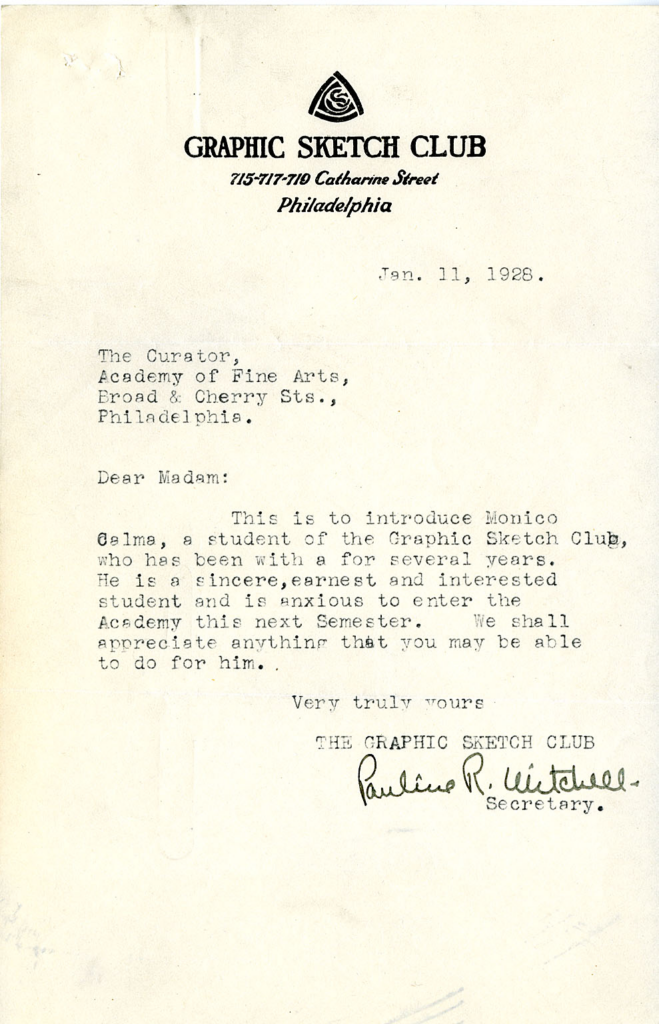
Archives are often viewed as static repositories, but they are most vital when they provide a foundation for active inquiry. During the summer of 2023, a research project by our intern Catherine Wan into the student records of Dr. Monico C. Calma (1905–1987) led to an ongoing effort between our institution and the Calma family to document the life of a former PAFA student.

By tracing Dr. Calma’s journey from his 1927 enrollment to his time as a Cresson Traveling Scholar, we have worked with the family to help fill in narrative gaps regarding his career after leaving Philadelphia. We are pleased to use our platform to share this work, as it reflects our commitment to honoring the accomplishments of Academy trained artists.

From Archive to Memoir

The collaboration has culminated in the family’s publication of Scraps of a Man’s Life, a memoir that expands upon the primary sources held in our collection. While our files document the official facts of his attendance, the manuscript provides a personal, human context. It captures the reality of a life balanced between manual labor in Alaskan salmon canneries and the rigorous, high-art environment of the Pennsylvania Academy of the Fine Arts and the Graphic Sketch Club.
A Bridge Between Labor and Art

Scraps of a Man’s Life is visually compelling, enriched by Dr. Calma’s original photography and sketches. These materials document a specific era with an intimacy that administrative records cannot replicate.

The manuscript details his evolution from a student seeking to “earn a good name” to a mature artist who declared, “For me alone, seeking to create what is beautiful is first.” His journey—marked by his 1931 European Traveling Scholarship and his return to the Philippines in 1936—offers a vital, firsthand account of the “Manong” generation experience.

Preserving a Shared History

The family’s dedication to curating this memoir serves as an essential contribution to the broader conversation regarding the Filipino experience and contributions to the international cultural fabric. By providing visibility to this project, we hope to ensure that this “seeker of light” remains a recognized figure in the story of international art education and PAFA’s role in training artists.

For those interested in the intersection of identity, education, and the immigrant experience, this memoir serves as an honest testament to one man’s pursuit of his craft. If you’d like to check out the manuscript, you can find it over on Amazon. Just a quick note: we don’t make any money or get paid for sharing this link, we just want to make it easy for you to find!

Note: The Pennsylvania Academy of the Fine Arts is pleased to highlight this research and the family’s memoir as a matter of historical interest. Please note that this is for informational purposes and does not constitute an institutional endorsement of the publication.
The Student Years: Edward Redfield’s Student Drawings Now Online

Before he became one of America’s most celebrated impressionists and a cornerstone of the New Hope art colony, Edward Redfield (1869-1965) was a student honing his craft at the Academy. We are thrilled to announce the recent acquisition of a small collection of Redfield’s student works, created between 1887 and 1889. These are particularly unique as students rarely preserved any of their student work.

The complete digitized collection is now fully accessible online via our Digital Archives, offering researchers, students, and art enthusiasts free access to these foundational works. Explore the new collection today and trace the early steps of a master landscape painter.

Collection Highlights

Pedagogical Insight: Gain a rare window into the traditional academic curriculum that shaped a generation of American masters under the influence of the Eakins-era PAFA framework.

Foundational Studies: Explore early technical exercises, including meticulous plaster cast and architectural ornament studies of leaves, hands, and feet.

Life Drawings: View advanced charcoal and graphite nude figure studies that demonstrate the rigorous anatomical training of the late 19th-century academy.

Reflecting on 2025: How We Connected with History and Art

As we wrap up 2025, we’re taking a moment to look back at how you—our researchers, students, and curious visitors—interacted with the Academy’s collections over the past year.

These patterns are more than just numbers on a spreadsheet; they offer a window into our community’s evolving needs and help us map out our future. It’s important to note that these figures focus specifically on research and resource requests—things like deep dives into our archives, library services, and access to works of art not currently on public display.


2025: A Year of Purposeful Research

In 2024, the Academy recorded 923 total research requests. As of mid-December 2025, that number stands at 892. While this is a slight 3.4% dip, the story behind the data is one of resilience.

This minor decrease was expected as the Academy transitioned away from degree-granting programs, leading to a smaller student population this fall. However, demand remains remarkably robust.

The Breakdown of Requests:

  • External Requests (63%): 562 inquiries came from the research community.
  • Internal Requests (37%): 330 inquiries supported our faculty, staff, and students.

The Digital Frontier: Global Reach, Human Connection

While our physical halls have seen shifts, our digital presence is exploding. The Academy’s Digital Archives recorded over 100,000 unique human visitors this year!

A standout star of our digital offerings remains the Rediscovering John Rhoden Digital Archives, which drew over 3,100 unique visitors. We are honored to continue stewarding Rhoden’s incredible legacy for a global audience.

New to the Digital Collection this year:

We’ve added 2,475 new items across three collections:

  1. PAFA Course Catalogs: A journey through our institutional history.
  2. Blanche Dillaye Drawings: Exquisite works now available to all.
  3. Chester Springs Student Registration Cards: A treasure trove for genealogists and historians.

A “New Normal” for In-Person Visits

How you visit us is changing. While email remains the primary way researchers start their journey, we’ve seen a “hybrid” rhythm emerge.

  • The Archives are Booming: In-person use of the Archives surged by 122% (111 visitors).
  • The “Walk-In” Surprise: We saw an unexpected rise in walk-in service, largely driven by our new cohort of certificate students seeking hands-on support.
  • A Shift in Scale: Total in-person interactions dropped from 885 to 428. This 52% decline was anticipated following the school’s transition, but it has paved the way for more focused, scholarly engagement.

Top 3 Reasons People Use the Archives:

  1. Academic Research
  2. Curatorial Research
  3. Provenance Research

What These Shifts Mean for Our Future

The data tells us three important things:

  1. Demand is High: Projects like the “A Nation of Artists“ exhibition and our upcoming 220th Anniversary celebrations continue to drive intense interest in our holdings.
  2. Archives are Essential: The massive jump in archival research proves there is a deep hunger for primary-source materials.
  3. Intentionality Wins: Visitors are coming to us with more specific, deep-seated goals. Our digital archives are serving as a gateway, allowing researchers to do their “homework” online before arriving for a high-impact physical visit.

Looking Ahead

These insights are vital. They allow us to plan responsibly—ensuring we balance broad digital access with the specialized, high-touch care required for on-site research.

Whether you reached out via email, spent hours in the reading room, or browsed our catalogs from across the ocean: Thank you. Your curiosity is what brings these collections to life. We can’t wait to see what you discover in 2026!

Exciting New Acquisition: Blanche Dillaye’s Collection Now Digitized and Open for Research!

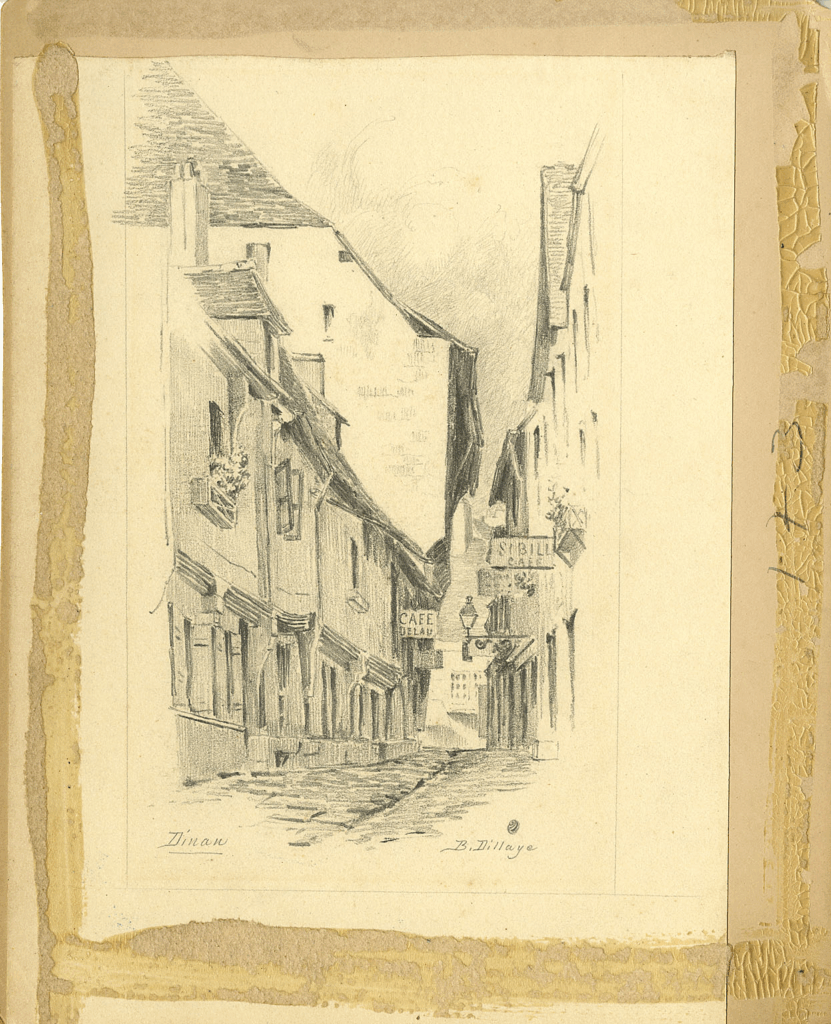
We’re thrilled to announce the recent acquisition and digitization of a remarkable collection of works by American artist Blanche Dillaye, dating from circa 1928. This newly available archive features 38 exquisite pencil sketches and one reflective poem, offering a rare glimpse into Dillaye’s travels and artistic vision during the late 1920s.

From the cobbled streets of Looe and Dinan to the architectural charm of Moret and the serene landscapes of Lelant, Dillaye’s drawings capture the textures, moods, and quiet beauty of European towns and countryside with masterful detail. Her accompanying poem, Trees, adds a lyrical layer to the collection, echoing themes of nature, presence, and timelessness.

Cobbled Street in Dinan, France (MS.2025.02-44)

Now fully digitized, this collection is open to researchers, educators, and art enthusiasts. Whether you’re studying early 20th-century travel sketching, American women artists abroad, or simply drawn to the elegance of pencil work, Dillaye’s collection offers rich material for exploration.

We invite you to dive into this evocative body of work and discover the world through Blanche Dillaye’s eyes. https://pafaarchives.org/s/digital/item-set/175232

Newly Digitized Collection Available Online: The PAFA School Catalogs 

Contributed by Sharon Yoon, Museum Collections Assistant 

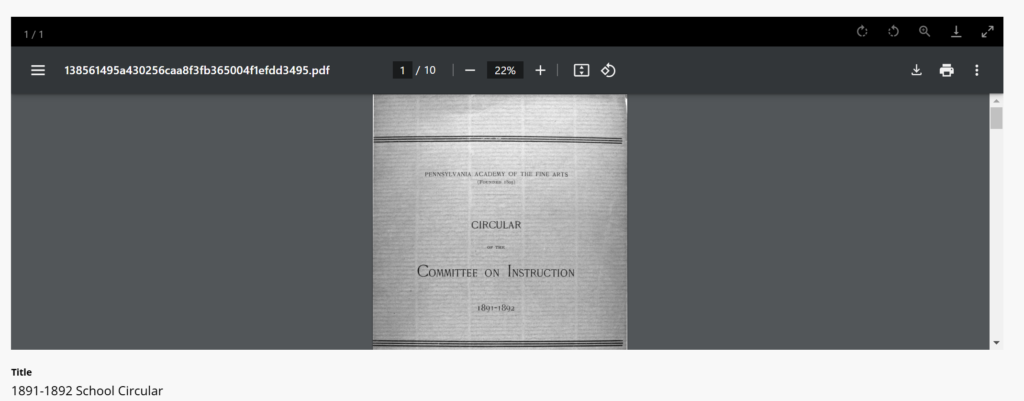
The PAFA School Catalogs are valuable archival records that help provide insight into over 130 years of school operations. Historically known as “Circulars”, the school catalogs provided students and prospective students with information such as school policies, programs, scholarships, schedules, fees, prizes, and instructors. After 1908, the catalogs included illustrations of classes, work by students, and exhibitions of student work. Catalogs from the 1920s show many views of classes and grounds at the Chester Springs campus. From 1940, photographs of faculty and their work were prominently featured.  

The catalogs provide important details on the curriculum, the instructors, and the overall artistic training environment at the Academy, making the collection particularly useful to those interested in 19th and 20th century American Art education.  

For this digitization project, collections staff continued using a DSLR/copy stand setup that was outlined from our pilot project in April 2024 (Testing a new method to digitize archival collections) .  

As there were over 100 catalogs (and nearly 4,000 pages!) to digitize, using a flatbed scanner for this project would have been time-consuming and inefficient for staff. Moreover, since the text was the most important aspect of the records, we were less concerned about the overall “image quality”. However, as mentioned in the previous blog post, a large obstacle that presented itself during this project was post-processing. Each image needed to be individually rotated, cropped, and color corrected. Afterwards, all the pages had to be converted and combined into a PDF file. These files were then organized by year and run through OCR software, which recognizes and converts text within images to be machine readable. Finishing this step resulted in 118 digital reproductions of the Academy’s school catalogs that are now freely available online: https://pafaarchives.org/s/digital/item-set/29807  

For more information on the school’s history, please see “School History” here: https://pafaarchives.org/s/digital/page/historicalresources 

Alumni Spotlight: Susan H. Bradley

Contributed by Hoang Tran, Director of Archives & Collections

As George Orwell wrote in 1984, “Who controls the past controls the future. Who controls the present controls the past.” For this reason, archivists play an essential role in preserving the memory and legacy of people, places, and things. Archivists are only one part of the equation. We need the help of scholars, historians, genealogists, and curators to guide our decisions on what materials should be preserved for posterity.

But what happens when records are not preserved? Moreover, who gets to be remembered and who is forgotten?

Using PAFA’s archives, I have been assisting the descendant of Susan H. Bradley (1851-1929) conduct genealogical research. Together, our work attempts to raise awareness of Bradley’s influence on the Philadelphia and Boston art scene during the late 19th and early 20th centuries.

Please read more about Bradley on the National Museum of Women in the Arts blog: Susan H. Bradley: A Rediscovered Powerhouse

Browse images of Bradley’s work in PAFA’s Digital Archives.

New Digital Collections

Contributed by Hoang Tran, Director of Archives

The Archives is happy to announce that staff have recently completed organizing and uploading two new digital collections.

The first digital collection of 627 photographs are part of the Alumni Gallery photographs. The photographs document the exhibition openings for 10 alumni gallery exhibitions from 2011-2014. The Alumni Gallery exhibits works by alumni from all of PAFA’s matriculating programs. Located within the Historic Landmark Building, the Alumni Gallery offers a contemporary view of PAFA’s longstanding traditions in art-making and is always free and open to the public.

Inaugural exhibition opening reception for PAFA’s Alumni Gallery, 2011.

The second digital collection is the Annual Student Exhibition and Graduation photographs which consists of 9498 photographs. The collection documents various year end events for students, specifically the Annual Student Exhibition; Preview Party; public opening; award and prize ceremony; luncheon; graduation and commencement ceremony; as well as alumni reunion party.

Graduating class of 2016
Family and friends attending 104th Annual Student Exhibition after graduation ceremony, 2005.

More information about PAFA’s Alumni Gallery and Annual Student Exhibition can be found in the online resources section (School History).

Helping our old neighbor, St. Stephen’s Episcopal Church

Contributed by Hoang Tran, Director of Archives

PAFA's Second Building, circa 1850s
PAFA’s Second Building

Many people may not know that PAFA was originally located in another section of Philadelphia. More specifically, in Philadelphia’s Market East neighborhood on Chestnut St. between 10th and 11th streets.

The neighborhood has dramatically changed since the early-mid 19th century but one of our neighbors remains to this day. St. Stephen’s Episcopal Church was founded in 1823 and still stands at 19 S. 10th Street Philadelphia, PA 19105.

saint_stephen27s_episcopal_church2c_philadelphia2c_pennsylvania_-_20110606

Recently, the church’s historian/curator Suzanne L. stumbled upon a large painting in the church with a PAFA label on the back. Naturally, she contacted me to facilitate research assistance.

20180515_001

We didn’t have a lot of information to work from but two historians, Suzanne and I, are better than one! We knew PAFA’s Annual Exhibition (1811-1969) would be the first place to begin our research. The label suggests the painting was at PAFA in April, the month the Annual Exhibitions were usually held.

The painting in question included a baptismal font that was created circa 1856-1857 and donated to the church a few years later in 1859-1860. We were able to date the painting using these details. The painting was not signed so there was no name to search. It did include a monogram but it was a bit difficult to decipher.

We knew the image was an interior of the church, so the title of the painting should include the name of the church, St. Stephen’s. We browsed the Annual Exhibition catalogs and painting registers. After sifting through hundreds of names, titles, and donors, we finally located information that would verify the paintings provenance!

20180515_blog_002.jpg

Just from this one item in the archives’ collection, we were able to verify a number of facts:

  • Titled, Oil Painting, Interior of St. Stephen’s Church, Philadelphia
  • A. Zeno Shindler, artist
  • The painting was registered number 170
  • Annual Exhibition catalog number was 364
  • Painting was for sale for $250, but did not sell and returned to the artist

Armed with this newfound information, Suzanne knew her work was not complete. The next phase of her research was to conduct more research on the artist and figure out how the painting eventually made it to the church since it was never sold at the exhibition.

#Flashback Friday – Alumni Spotlight: Donald Erik Chandler

Contributed by Hoang Tran, Director of Archives

Donald Erik Chandler (1922-2005) was a creative artist who had a long professional career creating some of America’s most iconic characters.

Before becoming an artist, Chandler proudly served in the United States Navy during World War II. After he was honorably discharged on December 18, 1945, he applied to numerous art schools including the Corcoran School of Arts and Design in Washington D.C. and San Francisco State College.

20180420_blog_001
Student academic file for Donald E. Chandler, RG.03.03.02, Pennsylvania Academy of the Fine Arts, Archives

Almost two years after being discharged, Chandler applied to and was granted enrollment to PAFA with the support of the GI Bill. At PAFA, Chandler studied sculpture and went on to win the Stewardson Sculpture Competition Prize in 1949.

20180420_blog_002
Donald E. Chandler’s 1949 Stewardson Sculpture Competition Prize

After completing his training at PAFA, Chandler began his career as a technical illustrator to work on America’s Apollo program. Perhaps Chandler’s most notable and recognizable contribution was actually in the American film industry 25 years after leaving PAFA. His first big break was his 25 foot sculpture of a great white shark for the 1975 Steven Spielberg film Jaws. The following year, Chandler with a team of sculptors created a 40 foot tall King Kong sculpture used in the film. Other pop culture characters include his assistance on creating the Pillsbury Doughboy and characters for McDonalds–the Hamburglar, Grimmace, Mayor McCheese, Officer Big Mac, Captain Crook, the Fry Guys and the Hamburger Patch.

After Chandler’s death in 2005, his family made a contribution to name a school studio in honor of his memory. Even after all these years, his legacy still lives on here at PAFA in studio #1018. Thadius Taylor, a BFA + Certificate student is currently using the space to create art.

Don Chandler’s second cousin, Jeff Chandler, reached out to PAFA’s archives a few years ago to start the research process of compiling Chandler’s biographical information. Jeff recently published a short story about the artist’s personal and professional life and donated a copy of the book to the archives. Those interested in reading the book should contact the archives or you can access the digital copy here.