Contributed by Sharon Yoon, Collections and Technical Services Assistant
In the early 19th century, the Pennsylvania Academy of the Fine Arts (Academy) functioned as a vital conduit for transatlantic cultural exchange. For a young nation lacking established museums or classical ruins, these early acquisitions provided the essential technical infrastructure required to train American artists before a native artistic identity had fully emerged.
The Napoleonic Gift (1810)
In 1810, a significant diplomatic exchange occurred between the French Empire and the United States. John Armstrong Jr., the American Ambassador to France, received a collection of books and engravings from Napoleon Bonaparte, delivered via the Duke of Cadore.
Armstrong recognized the pedagogical value of these materials for a young art institution. In a letter dated December 28, 1810, he formally offered the collection to Academy President George Clymer:
“Believing that I cannot better fulfil this original intention than by offering it to the acceptance of the Academy of Fine Arts, I have now the honor of doing so…”
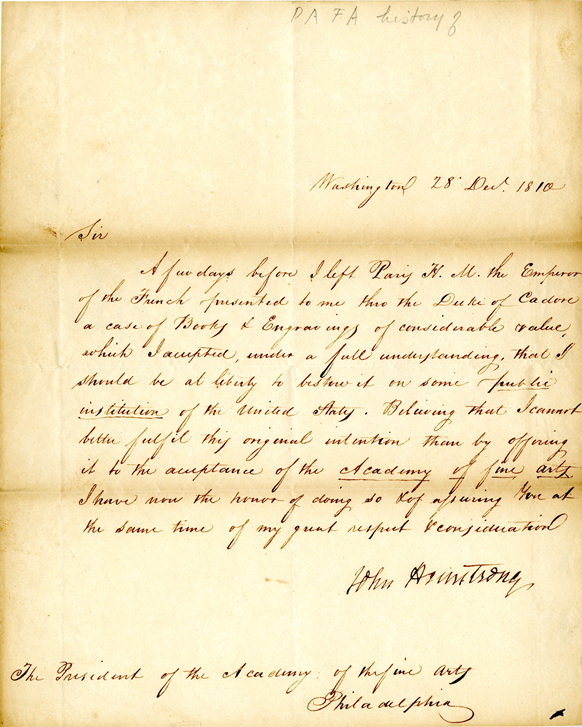
Washington 28 Dec. 1810
Sir
A few days before I left Paris H. M. the Emperor of the French presented to me thro’ the Duke of Cadore a case of Books & Engravings of considerable value, which I accepted under a full understanding, that I should be at liberty to bestow it on some public institution of the United States. Believing that I cannot better fulfil this original intention than by offering it to the acceptance of the Academy of Fine Arts, I have now the honor of doing so and of assuring you at the same time of my great respect and consideration.
John Armstrong
The President of the Academy of the Fine Arts
Philadelphia
This gift comprised 24 volumes of etchings by Giovanni Battista Piranesi and his family. These detailed renderings of Roman architecture became primary teaching resources, allowing Academy students to study classical proportion and perspective without traveling abroad.
The Smith Donation and International Law (1813)
The Academy’s instructional library and collection were further expanded in 1813 by a major gift from Joseph Allen Smith, consisting of paintings, plaster casts, and engravings.
The provenance of this collection is a landmark in international law. During the War of 1812, the ship transporting Smith’s gift was seized by the British as a “war prize.” However, a Nova Scotia Vice-Admiralty Court eventually ordered the cargo’s release. The ruling established a global precedent: that cultural and scientific property are exempt from the rights of warfare—a principle that remains a cornerstone of international art law today.
For more information on the ship seized by Britain:
- https://time.com/archive/6868704/art-halifax-gentleman
- https://loyalist.lib.unb.ca/atlantic-loyalist-connections/license-piracy
A Legacy of Modern Scholarship
Together, the Napoleon and Smith gifts provided the intellectual capital necessary for America’s first art academy. These resources remain active assets for modern scholarship. Recently, researcher Stephen Lauf consulted the Piranesi volumes to advance his research on 18th-century printmaking and architectural history. Such collaborations continue to generate new insights into the Academy’s foundational holdings. His multiple visits to the archive were a delight to staff and sparked multiple interesting conversations on the works, processes, and history of the Piranesi family etchings. Thanks to Lauf, Academy staff also walked away from his visits with new knowledge and insights into the volumes.
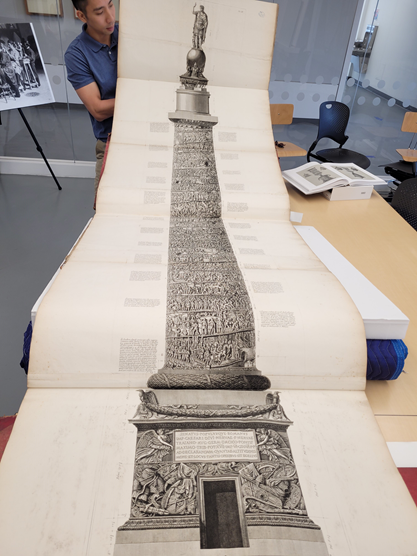
Photo courtesy of Stephen Lauf
For more information on Lauf’s interesting research, please visit his website: https://www.quondam.com/index.htm
Through the preservation of these imperial and diplomatic gifts, the Academy ensures that the fundamental resources that shaped the first generations of American artists remain accessible to inspire the next.
