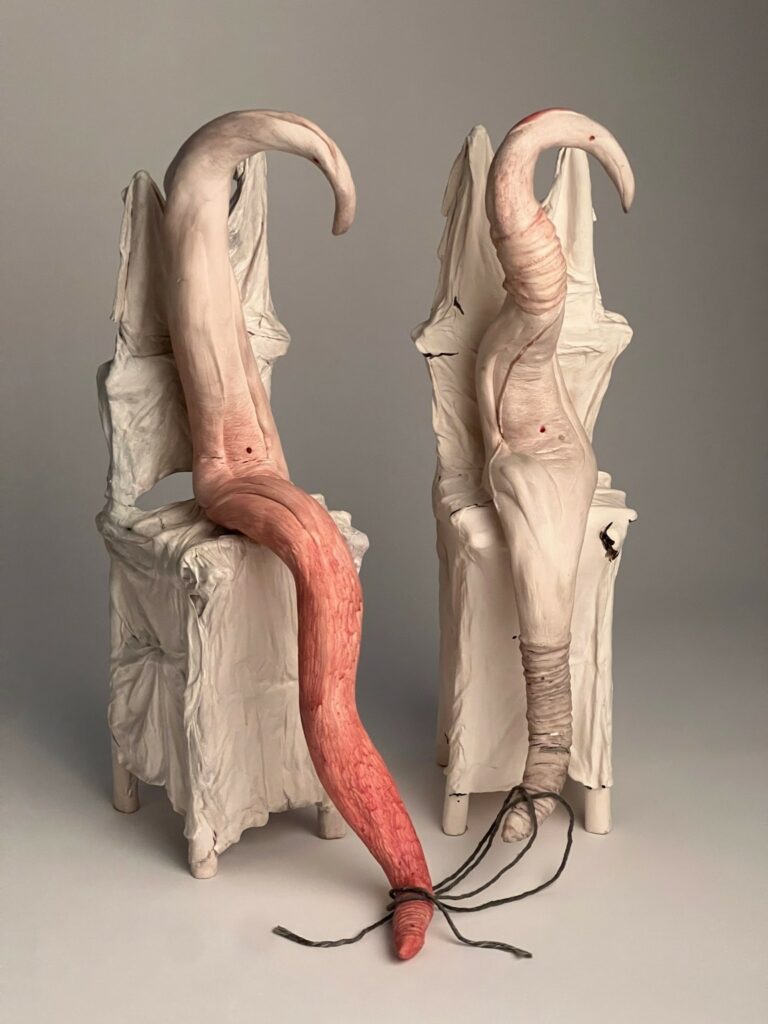
Behind the Scenes: Photographing Unique 3D Objects

Contributed by Sharon Yoon, Collections and Technical Services Assistant and Zoe Smith, Digital Studio Technician

Digitizing museum objects is a core function of collections management. High-quality imaging supports scholarly research, facilitates exhibition planning, and provides greater access. By adhering to rigorous post-processing standards, the Academy ensures that visual records remain viable for long-term digital preservation.

Case Study: Linda Kramer, The Prisoners of Love, 1982. Porcelain china painted, 22 x 14 x 12in. Funds provided by Robert and Frances Coulborn, 2016.2
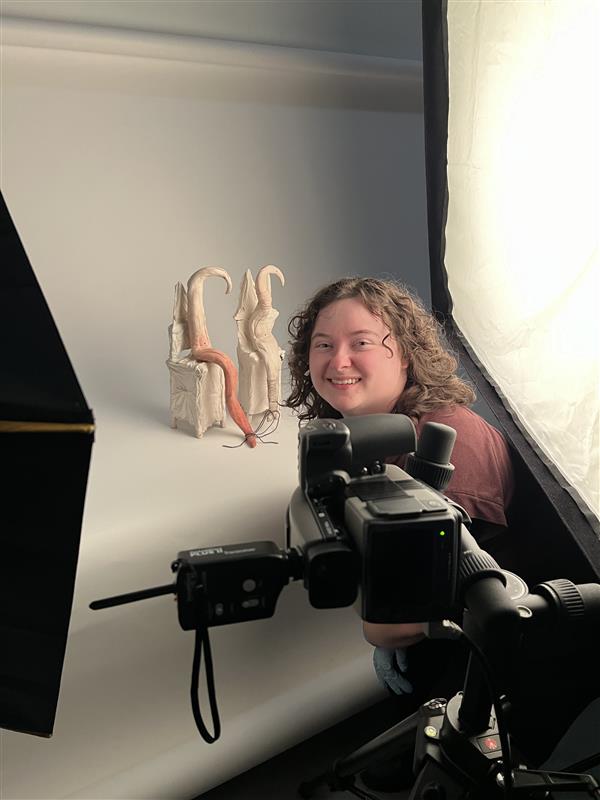
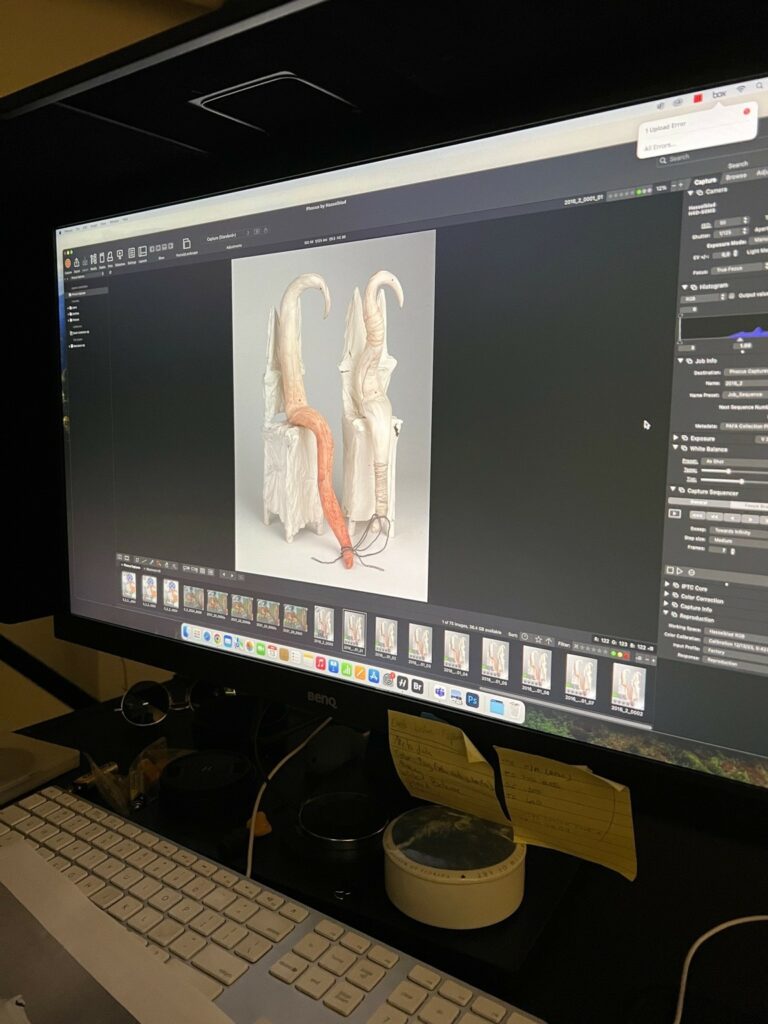
Photographing complex, multi-part objects requires technical precision balanced with stringent handling protocols. The work by Linda Kramer consists of four distinct, delicate porcelain components. Due to their fragile, irregular geometry and lack of independent stability, the session required a coordinated workflow between the photographer and the collections team.

Workflow

  • Pre-Capture Verification: Each component was positioned according to archival reference photos to ensure the artist’s original intent was maintained.
  • Staged Handling: Transfers and rotations were executed with deliberate, slow-motion to mitigate the risk of damage.
  • Lighting and Surface Analysis: Lighting was configured specifically to highlight sculptural depth and ceramic surface texture without overexposure.
  • Real-Time QC: Images were tethered to a workstation for immediate review, allowing for instantaneous adjustments to focus and exposure.

Data Integrity and Post-Processing

Following the physical session, the files underwent a standardized post-processing phase:

  • Color Calibration: Accurate color representation was verified against physical color targets.
  • Master File Archiving: High-resolution TIFF files were generated as the preservation masters.
  • Access Derivatives: Web-ready copies were created for the Academy’s internal databases and digital platforms.

Impact

This process represents a critical intersection of documentation and stewardship. Each digital surrogate allows the work to be studied and shared without the physical risk associated with repeated handling of the original media.

Newly Digitized Collection Available Online: Chester Springs Student Registration Cards

We are thrilled to announce the completion of a major digitization project within the PAFA Archives: The Chester Springs Student Registration Cards. (https://pafaarchives.org/s/digital/page/chester-springs) For decades, these cards have been the primary—and often the only—proof of a student’s time spent at PAFA’s historic summer campus. Now, for the first time, this entire collection is available online, offering a searchable window into the lives of over 2,300 artists who studied in the rolling hills of Chester County.


A Legacy of “Open-Air” Art

In 1917, PAFA embraced the Impressionist-led “plein air” movement by opening the Academy Country School (popularly known as Chester Springs). Located about six miles from Phoenixville on a site steeped in history—from a pre-Revolutionary medicinal spa to a Revolutionary War hospital—the campus offered 100 acres of creative freedom.

Until its closure in 1952, the school was a vibrant village of art. A former hotel served as a dormitory, while barns and sheds were transformed into sun-drenched studios. Students spent six-week sessions painting landscapes, open-air figures, and still lifes, balanced by games of tennis, croquet, and swims in the local pools.

What the Collection Reveals

The archives has digitized every single student registration card from the Chester Springs records. This extensive list of 2,315 individual names provides vital documentation that can confirm:

  • Personal Details: Registered names and home addresses.
  • Academic History: Specific dates of attendance and courses taken.
  • Financial Records: Tuition and fee payments.
  • Special Distinctions: Notes on veteran status (GI Bill), scholarship awards, and even dormitory assignments.

Each entry allows you to click the student’s name to view the scan of their original index card. Because many artists returned year after year, these cards are displayed sequentially to show their growth and history with the school.


Start Your Research: Specialized Browse Lists

To help you navigate this vast collection, we have curated several specialized categories. Whether you are a genealogist, an art historian, or just curious about the Academy’s history, these links provide a great starting point:


A Collaborative Effort

This project was made possible by the dedicated work of our staff and PAFA students. We would like to extend our deepest thanks to the project contributors:

  • Sharon Yoon, Museum Collections Assistant (Project Lead)
  • Lily Kalinovsky, PAFA BFA (Lead Digitization Technician)
  • Nina Clifton, PAFA BFA
  • Victor Surbrook, PAFA BFA
  • Hoang Tran, Director of Library, Archives, & Collections

A Note on Accuracy: While we have made every effort to transcribe these names accurately, historical handwriting can be a challenge! If you believe a name has been transcribed incorrectly, please contact the Archives.

Digital Treasure Trove: Introducing the New Museum Collections Assistant

Contributed by PAFA Museum Collections

The Museum Collections Team is pleased to introduce L Autumn Gnadinger (they/them/theirs), who will be stepping into the role of the Museums Collections Assistant through the remainder of the IMLS grant project. L is an artist, writer, and educator with a background in museum work. They earned their MFA from Tyler School of Art and Architecture and have previously studied at Indiana University Southeast in New Albany, IN and Transylvania University in Lexington, KY. L is a former Core Fellow of Penland School of Craft in Bakersville, NC, and an editor and co-founder of the journal Ruckus, which engages art in the American Midsouth and Midwest.

With a range of experience in photography, design, and file management stemming from their work with Ruckus, L will be helping PAFA with its core goals of photographing works of art in the permanent collection, updating the file management connected to the permanent collection, and finally testing out the new content management system for the new—forthcoming—online collection.

About the Institute of Museum and Library Services

The Institute of Museum and Library Services is the primary source of federal support for the nation’s libraries and museums. We advance, support, and empower America’s museums, libraries, and related organizations through grantmaking, research, and policy development. Our vision is a nation where museums and libraries work together to transform the lives of individuals and communities. To learn more, visit https://www.imls.gov/and follow us on Facebook and Twitter.